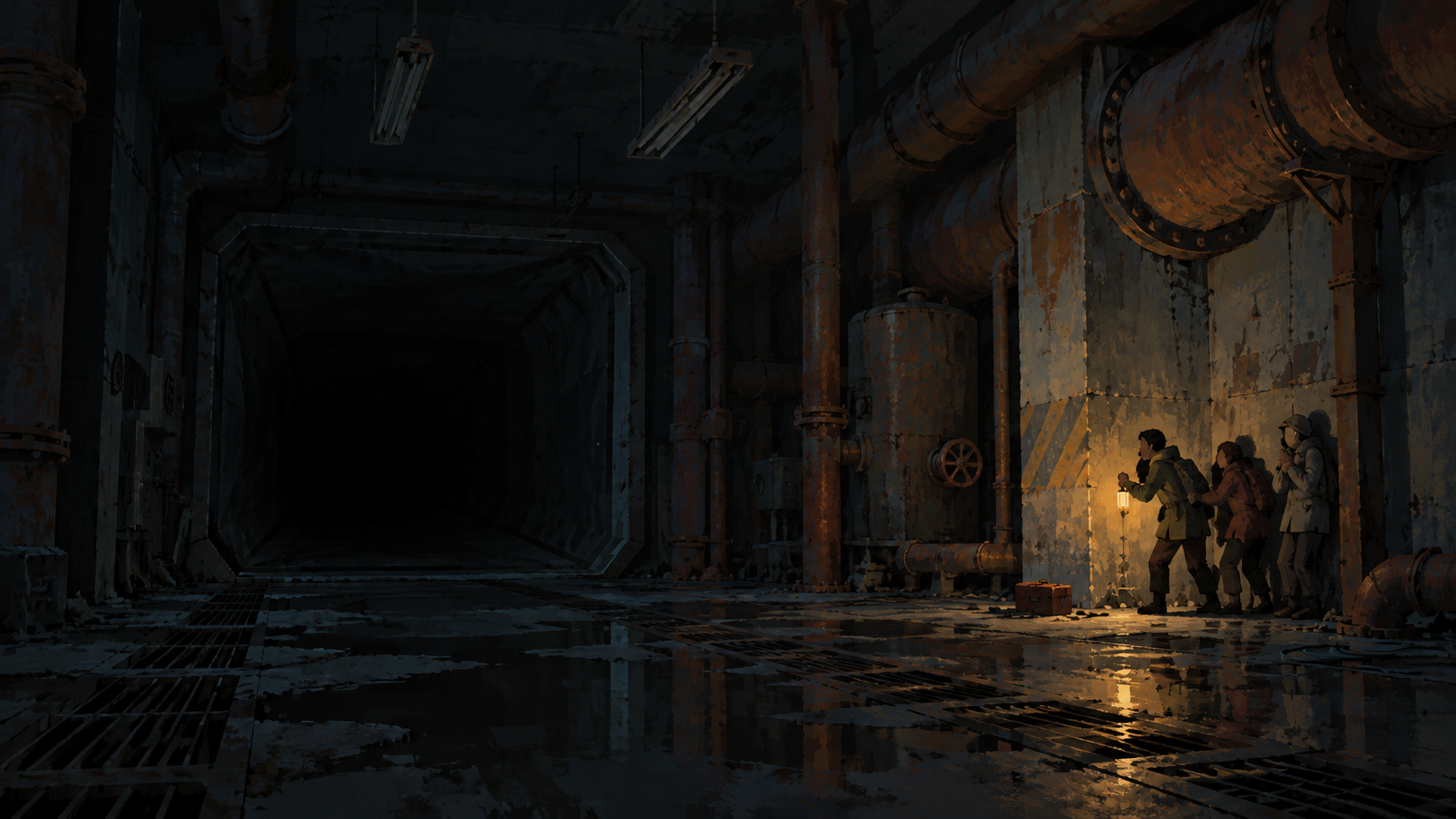
What is through a gate: how a coordinate is generated, and what is down there.
Beyond the gate
A coordinate is an address, and the map it opens onto.
You visit one. You do not settle one — the game will say so if you try to put one on the books.
Depth
Every coordinate is a 300 by 300 map. What changes with depth is how that space is divided.
| Depth | What it is like |
|---|---|
| 1 | Around 36 rooms, large and open, including one grand hall more than twice the size of any other room |
| 2 | Around 49 rooms, smaller |
| 3 and deeper | Around 60 rooms — a warren, at the ceiling |
The first band is the fewest and largest spaces you will see. Going deeper means more rooms, more branching corridors, and less open floor.
Rooms too wide for a roof to span unaided carry pillars, which is why the largest spaces read as built rather than drawn.
The lighting is the building's own. A fitted fluorescent strip hangs in every bay between the pillars and every few cells down each side of a corridor, flat and even, running off whatever the place runs off. None of it draws from your generator, and none of it is yours to take down for parts.
Corridors are rooms too. They are walled and floored in the same material as the rooms they join, and a door stands across the middle of every long run, so a hallway is revealed by walking it rather than all at once.
A few spaces are sealed, with no corridor reaching them at all. Their contents are unreachable until you dig, which is the point of them.
What a room is made of
The shallow rooms are the yellow ones: wood and worn plank, sparse, wrong in the way you expect.
Deeper, the building material changes with depth, and each look covers a whole place rather than one room:
| Poolrooms | Wet tile and hard light |
| Machinery | Plate, grating and grease |
| Abandoned offices | Worn carpet under dead strip light |
| Cold storage | Concrete and frost |
| Wrong | Where the place stops agreeing with itself |
| Undercroft | Old flagstone under a newer building. You have gone below the thing somebody built |
Which one you get follows depth with some variation, and it is fixed per address — a place looks the same every time you return.
Undercroft is the deepest look and you will only see it at the bottom. The deeper a place sits, the further down this list it lands, and the deepest ones stop varying: once you are as deep as you can get, the place wears the last face on the list.
What a room is built from is also salvage: steel walls are steel.
Further in, the furnishing stops pretending too. Rooms are furnished as laboratories, workshops, nurseries and dormitories. Runs of rooms are furnished as one place rather than three. Corridors have something in them now and then.
Nothing down there is work until somebody has seen it. A planter, a bench or a shelf in a room nobody has entered is forbidden, and a shelf is nobody's storage. Walk in and the forbid lifts; what you do with it after that is yours to decide.
Things move
Go back to a space you have been before and something will not be where you left it.
Nothing tells you, and not every time.
Bands
Every coordinate has a band — how hostile it currently is.
It rises with depth and with what your colony is worth, and it decides what comes looking for your crew.
The Atlas pane prints it, so you never have to learn a band by being hurt by it.
The Atlas
| Surveyed rooms | Appear with what connects to what |
| Unsurveyed rooms | Blank |
| Link list | Needs route telemetry unlocked first |
What lives there
Wanderers, the missing, the dead, survivors worth bringing home — and things that are none of those.
Nothing starves or rots before you have found it. Discovery starts their clock, not your exploring speed.
What follows you
At the hostile band, an inhabitant will hunt your crew as far as the threshold.
Only that far, with one bounded exception: at the deepest band, through an advanced gate, while an opening is live, something that fits may step through behind them. It then behaves like anything else that got inside your base.
Closing the connection before it arrives is what stops it.
A gate is never an objective, a lure or a spawn target. Nothing is ever drawn toward one.
Nothing leaks in
Inhabitants come from this mod's own roster only. No content from any other mod appears in Backrooms generation.
Bringing something back
One point of a crossing is a record. It is the one the company pays for.
| Step | Where |
|---|---|
| 1. Record a route, a distortion and an entity observation | In the field |
| 2. Analyse it | A bound laboratory, by a pawn, over time |
| 3. Have a second person review the report | Operations → Investigation |
| 4. Spend the insight | A company project |
The Investigation pane shows which of the three parts each recording still lacks.
None of these steps is timed. A recording waits as long as you need it to.
A coordinate is a map you can use
A coordinate is a real map and it belongs to you. Everything you can build at home you can build down there, and it behaves the same way, because nothing about it is a special case.
So a space you surveyed once is a space you can keep. Some of what people do with them:
| Use it as | What makes it work |
|---|---|
| A prison | Beds, a door, a prisoner. A prisoner can cross the gate themselves if your zoning and the door allow it, and they stay your prisoner on the other side. Wardening crosses, and so does the food |
| Storage | Ordinary stockpiles and shelves. Nothing deteriorates under a roof that thick |
| An isolated safe room | One room, one door, nothing that leads anywhere. A coordinate has no neighbours |
| A workshop | Benches and bills. Every bill family crosses: cooking, crafting, smithing, tailoring, art |
| A mine | The rock is real rock. Mining crosses, and a coordinate carries three times the ore of an ordinary map |
| A farm | Growing and animal handling both cross. It is roofed, so you want sun lamps and the power to run them |
| A field hospital | Doctoring, patient feeding and rescue all cross |
Twenty-one of the game's twenty-three work types cross a gate. The two that do not are being a patient and resting in bed, which are things that happen to a pawn rather than jobs you assign.
You are not pushed toward any of it. A branch that would rather live down there, mine the rock and grow food under thick roof is playing correctly, and nothing nudges them.
What a coordinate is worth to mine
Three times the ore of an ordinary map, and the ordinary map it is three times is the tile you are standing on. A coordinate under flat country is poorer than one under mountains, exactly as two colonies on those tiles would be — the mod reads the game's own figure for the tile and multiplies it, rather than keeping a number of its own.
On top of that: every sealed vault has a vein running to it, and a door that opens onto nothing usually has one behind it. Those are the deposits worth finding rather than worth counting.
Two honest limits
No guests arrive. A coordinate is not a settlement on the world map, so faction visitors and caravans have nowhere to travel to. Guest quarters and any mod's hospitality content belong at your surface base, where they work exactly as they always have.
It is dark and sealed. No sunlight, no weather, no rain, and the roof is thick rock — so nothing drops through it either. That is why it keeps things so well and why anything that grows needs lamps and the power to run them.
Selling from down there
You do not have to haul it home to get paid. Designate a trade beacon as a credit beacon in a coordinate and everything valuable inside its radius sells where it stands, straight into the company account.
And what you dig up down there is worth more than the same thing from home, because of the next section.
Odd goods
Anything carried out of a coordinate is marked odd and never stacks with the ordinary kind.
A thousand odd cotton is a thing you went and fetched, not a thing you grew. Buyers turn up wanting goods by origin and paying well over the ordinary rate.
The company pays ×1.5 for odd goods and ×0.85 for ordinary valuables. So a mine or a farm on the other side of a gate is the better-paid half of the economy, not a detour from it.